We provide lender-ready capital raise packaging and debt or equity placement support for business owners and buyers looking to secure serious term sheets and close funding on a defined timeline.
Get Started With Financely
For business owners and acquirers pursuing private debtsubmit your deal for review. We revert within one working day with next steps and either a quote for our services.
Agentic AI for Shopping: 8 Product Page Fixes for Brands
Find The Right Lender Faster. Access 12,000+ Lenders.
AI Lender Match helps business owners, investors, and sponsors identify lenders that fit their deal profile without wasting weeks on cold outreach. Get a smarter starting point for acquisitions, commercial real estate, trade finance, and structured debt transactions.
Agentic AI for Shopping: What Ecommerce Brands Should Fix on Their Product Pages
Agentic AI for shopping is moving from experiment to genuine sales channel. In its October 2025 research, McKinsey estimated
that AI agents could orchestrate USD 900 billion to USD 1 trillion of US business to consumer retail revenue by 2030, and USD 3 trillion to USD 5 trillion globally. Whether or not the final number lands there, the direction is clear. More purchases will begin with a customer telling an AI assistant what they want and letting it handle the research.
That changes who reads your product pages. An AI shopping agent is unmoved by clever taglines or lifestyle photography. It scans for facts, compares them against the shopper's requirements, and moves on quickly if the information is missing, vague or contradictory. This guide sets out the product page problems that most often cost brands a place on an agent's shortlist, and how to fix each one.
How does an AI agent read a product page?
An agent typically pulls information from several layers at once, then matches those details against a request such as "waterproof hiking boots under USD 150, wide fit, delivered by Friday." If any detail is hidden, unclear or inconsistent, the agent has two options, guess or skip. Well designed agents usually skip, because recommending the wrong product erodes the shopper's trust in the assistant.
Structured data
Product, Offer, shipping and return markup in the page code gives the agent machine-readable facts it can trust without interpretation.
Visible text and specifications
Descriptions and specification tables supply the attributes an agent filters on, such as materials, dimensions, fit and compatibility.
Price and stock status
Current price, currency and availability by variant decide whether the product can be recommended at all.
Reviews and policy pages
Detailed reviews and clear delivery and return terms give the agent evidence that the product fits the shopper's specific need.
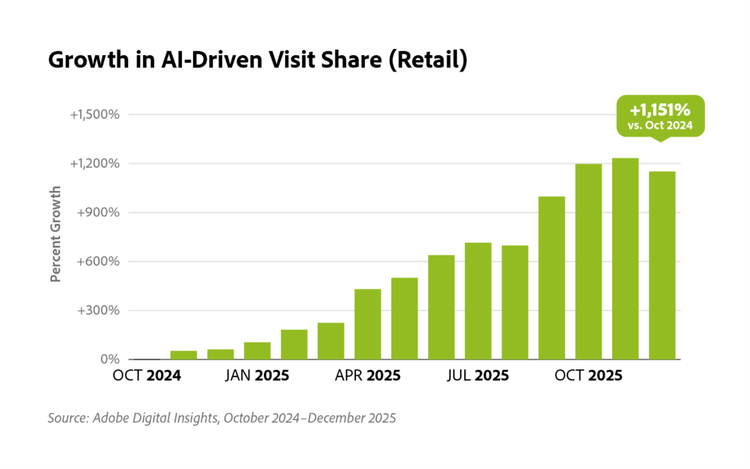
The traffic is already arriving. Adobe Analytics, which covers more than 1 trillion visits to US retail sites, reported that AI-driven traffic to retail sites rose 693% year over year during the 2025 holiday season. Yet much of what retailers publish still goes unread. In data reported by Digital Commerce 360
in June 2026, Adobe found that even in the best performing retail sectors, 30% to 40% of the content on high-value pages was overlooked or uncaptured by AI.
Fix 1: Complete your structured data
Schema markup is the most direct way to hand an agent clean facts.
At minimum, each product page should carry Product and Offer markup covering name, brand, price, currency, availability, condition and a unique identifier such as a GTIN or MPN. Add shipping details and return policy markup where your platform supports them, along with review data based on genuine customer ratings.
Test your markup with Google's Rich Results Test
and confirm that it matches what shoppers see on the page.
Fix 2: Replace vague copy with specific attributes
"Premium quality" and "perfect for any occasion" give an agent nothing to work with."Full grain leather upper, rubber outsole, 2.1 lb per pair, available in wide widths" gives it plenty.
Go through your best sellers and list every attribute a buyer might filter by, including materials, dimensions, weight, compatibility, capacity, care instructions, certifications and intended use. Then write those details into the copy in plain language.
Fix 3: Put key details in plain HTML
Many stores load specifications, prices or stock levels with JavaScript after the page opens, or tuck them inside tabs that only render when clicked. Some AI crawlers process scripts only partially, so that information may go unseen.
Server render the essentials, meaning price, availability, the main specifications and variant options. Tabs are fine for human visitors as long as the content exists in the page source.
Fix 4: Make shipping and returns easy to find
Delivery speed and return terms decide many purchases, and agents often treat them as hard requirements.
A policy buried behind a footer link, or described differently on two pages, creates doubt.
State shipping costs, delivery estimates and the return window on the product page itself, and keep that wording consistent with your policy pages.
Fix 5: Keep price and stock consistent everywhere
Agents may compare your product page with your merchant feed, marketplace listings and structured data.
If the page says USD 89, the feed says USD 95 and the markup lists a sold out size as in stock, the agent has no reliable answer to give.
Sync these sources automatically wherever possible, and audit them on a regular schedule.
Fix 6: Give reviews real substance
Star ratings help, but detailed reviews help far more.
An agent searching for "a stroller that folds with one hand" benefits from reviews that describe exactly that experience.
Encourage customers to explain how they use the product, and display reviews as crawlable text rather than inside an image or a widget that loads late.
Fix 7: Answer common buyer questions on the page
Your support tickets and pre-sale chats already contain the agent's questions.
The ones that keep coming up, such as sizing, compatibility or assembly time, belong in a short Q&A section on the product page. This hands agents ready made answers and tends to reduce returns at the same time.
Fix 8: Confirm that AI crawlers can reach you
Your robots.txt file and security tools may be blocking AI crawlers without anyone on your team realising it.
Review whether you allow search focused bots such as OpenAI's OAI-SearchBot
and PerplexityBot, and check that your bot protection services reflect those decisions.
Blocking every AI crawler also blocks the systems that could recommend you.
For any store counting on agentic AI for shopping to bring in new customers, a blanket block is a commercial decision, not just a technical setting, and it deserves review at management level.
Product page issues at a glance
Common product page issue
What the agent experiences
Fix
Missing or partial schema
Has to guess price, stock or brand
Complete Product and Offer markup
Marketing-heavy descriptions
Finds no attributes to match
Add specific, measurable details
Specs loaded by scripts
Sees an empty or partial page
Server render essential content
Hidden return policy
Treats the purchase as higher risk
Show returns and shipping on the page
Conflicting prices
Has no confirmed cost to report
Sync feeds, pages and markup
Thin reviews
Lacks evidence for specific needs
Collect detailed, use-based reviews
Blocked crawlers
Reaches nothing at all
Review robots.txt and bot settings
Final takeaway
Product pages were built for people who scroll, skim and click. The next wave of shoppers will often send an assistant ahead of them. Brands that give that assistant complete, consistent and specific information will be easy to recommend, while stores that lean on vague copy and hidden details will slip off shortlists without ever learning why.
Audit your top ten product pages against the fixes above, close the gaps you find, and position your store to benefit as agentic AI for shopping becomes part of everyday buying. The same discipline applies well beyond retail, which is why Financely applies it in its SEO for financial services companies.
Scaling an ecommerce brand?
More AI-referred demand means more inventory to fund. Financely structures and arranges working capital and asset-based lending
for growing ecommerce and consumer brands, preparing the credit file lenders need to say yes.
Is a separate website needed for AI shopping agents?
No. The fixes that help agents, such as clear facts, fast pages and consistent data, also help human shoppers and traditional search. One well built site serves both.
Which product pages should be fixed first?
Start with best sellers and high margin items. Then move to categories where shoppers compare many similar options, since that is where agents do the most filtering.
How can I tell if agents are recommending my products?
Ask several AI assistants the kinds of shopping questions your customers ask, and track AI referral traffic in your analytics. Changes over a few months will show whether your fixes are working.
About the author
Derek Iwasiuk
has more than 20 years of experience as a strategist and SEO for organisations in highly competitive industries. He helps businesses improve their visibility and optimise their presence on search engines and AI systems at Searchtides.com.
This article is a guest contribution and is provided for general information only. It does not constitute legal, tax or investment advice. Financely is an advisory and arranging firm, not a lender or broker-dealer. Any financing is subject to underwriting, due diligence, credit approval, documentation and conditions precedent, and no outcome or timeline is guaranteed.
Before you submit
Your deal, assessed by people who close
Your financing request goes straight to the principal. You receive a written diagnosis, the proposed structure and a one-off retainer before any work starts.
Recent mandates include a USD 150m revolving credit facility and a USD 12m acquisition closed in 21 days. We are an advisory and arranging firm, not a lender, and you close directly with the lender.
Financely is an advisory and arranging firm, not a lender or broker-dealer. All financing is subject to KYC, AML, due diligence and lender credit approval. No outcome or timeline is guaranteed.
Still Have Questions? Schedule a Consultation
If you still have questions after visiting ourFAQandProcedurepages, we invite you to book a paid consultation for personalized guidance. A $250 USD fee applies per session.
Important Resources
Popular Services
Security notice: we are aware of third parties using Financely’s name without authorization.Only emails sent from our official domains and communications through our portal are valid. Please verify any outreach before sharing documents or sending payments, and read ourimpersonation warning.
About Financely
Financelyadvises growth-focused businesses on accessing capital by introducing their opportunities to professional investors. Financely is not a securities broker or dealer. Where appropriate, engagements are coordinated with regulated broker-dealers, investment banks, legal counsel, and other specialists.
All mandates start with an RFQ. We review submissions, issue a brief Go/No-Go memo, and where bankable, release a Term Sheet that leads to funding. We arrange capital across Senior Secured, Unitranche, Second Lien/Mezzanine, Preferred Equity, and Gap Solutions. We do not process deals by email or chat.
Trade Finance
Letters of Credit, Standby LCs, Confirmations, Receivables Finance, and Inventory Lines with control.
LCs and Confirmations
SBLC and Guarantees
AR/AP and Supply Chain
Funding arranged for trade flows with instruments sized to your cycle and aligned to delivery and settlement.
Move forward to secure working capital and keep goods moving. Submit the RFQ to start underwriting for funding.
KYC and Source of Funds required. Engagements are best-efforts and subject to underwriting. Preference for operating companies with meaningful revenue.
See our FAQ
and Procedure.
Financely Inc. (“Financely”) provides corporate-finance advice and is wholly owned by Aurora Bay Trust, a trust formed under Bahamian law, together with its authorized affiliates. Depending on deal structure, jurisdiction, and local rules, engagements may be carried out through Financely Group LLC, a non-deposit-taking, non-banking financial company; Ashford Capital Advisory LLC; or another related entity.Financely and its affiliates are not registered as securities broker-dealers and do not execute securities transactions or hold client funds or securities. When a mandate involves the purchase or sale of securities and a registered intermediary is required, any orders are introduced to and executed by one or more independent U.S. broker-dealers registered with the SEC and FINRA. Those broker-dealers are solely responsible for trade execution, custody, and related regulatory obligations. Nothing in this material constitutes an offer, solicitation, or recommendation to buy or sell any security or to engage in any specific transaction. Before engaging Financely Group LLC, Ashford Capital Advisory LLC, or any affiliate, you are responsible for confirming that such engagement complies with your own legal, regulatory, tax, and other requirements. In the United States, certain advisory activities may be conducted in reliance on exemptions available under the Investment Advisers Act of 1940, including the “foreign private adviser” exemption where applicable. Our services and regulatory status may vary by jurisdiction and by transaction type.Clickhereto download our brochure. Emailsupportdesk@financely-group.comfor general enquiries.Click hereto view the complete regulatory disclaimer.