
Gold Trade Finance: Doré, AISC, Royalties and Streams
Find The Right Lender Faster. Access 12,000+ Lenders.
AI Lender Match helps business owners, investors, and sponsors identify lenders that fit their deal profile without wasting weeks on cold outreach. Get a smarter starting point for acquisitions, commercial real estate, trade finance, and structured debt transactions.
Gold Trade Finance Explained, From Doré to Streams and Royalties
Gold trade finance is one of the most misunderstood corners of commodity finance. The physical chain is short and heavily documented. A mine pours gold doré, an accredited refiner turns it into bullion, and that bullion settles in a wholesale market where price is set by the market, not by the seller.
This guide covers the supply chain, gold doré, all-in sustaining cost (AISC) and how it is proven, the margins miners actually earn, and the financing structures institutional capital uses in gold, from prepayments and gold loans to royalties and streams. It is written for producers, traders and sponsors preparing a gold financing for credit review.
The physical gold supply chain
Every legitimate ounce follows the same path, and every handover in that path generates paperwork a lender can check.
1. Mine and doré
The mine extracts and processes ore, then pours gold doré, a semi-pure bar of gold alloyed mainly with silver. Doré is feedstock for a refinery, not a tradeable investment product.
2. Accredited refiner
Doré is shipped to a refiner such as Valcambi, PAMP, Metalor or Rand Refinery. The refiner assays the metal, refines it to at least 99.5% purity and casts bars. Only refiners on the LBMA Good Delivery List can supply bars into the London market.
3. London Good Delivery bars
The wholesale unit is the Good Delivery bar of roughly 400 troy ounces with a minimum fineness of 995.0, as set out in the LBMA Good Delivery List Rules (2026). Each bar carries the refiner's mark, serial number, fineness and year.
4. Bullion banks, traders and central banks
Bars then move through bullion banks, physical traders and vault operators to end holders such as central banks, ETFs and fabricators. Structured financing along this leg is covered in our structured commodity finance practice.

Gold doré: the mine's product
What doré is. Gold doré is the bar a mine pours on site after processing ore, typically through leaching, carbon recovery, electrowinning and smelting. It is an alloy of gold and silver with small amounts of base metals and impurities.
Composition varies widely. Many gold-dominant mines pour doré in the region of 80% gold, but there is no standard. A refining agreement filed by Gold Resource Corp with Johnson Matthey, for example, describes doré of roughly 30% gold and 70% silver. The assay, not the label, sets the value of each bar.
How doré is sold. The mine ships doré to a refiner under a refining agreement. The refiner weighs, samples and assays each lot, then credits the mine with an agreed return rate, a percentage of the gold and silver content, less a refining charge. That charge is typically a fixed fee per payable ounce and does not move with the gold price. Settlement happens in refined metal credited to the mine's metal account or in cash at the market price.
Why doré matters to lenders. Doré is where production becomes provable. Shipment records, assay certificates and refinery settlement statements tie claimed output to ounces actually received and paid for, which is why most gold financing is secured on doré flows, refinery receivables or the refined metal itself.
AISC explained
A standard definition. All-in sustaining cost follows the World Gold Council Guidance Note on all-in sustaining costs and all-in costs, first issued in 2013 and updated in 2018. Its purpose is to show, as closely as possible, the full cost of producing and selling an ounce of gold on a basis that reconciles to audited accounts.
What goes into it. AISC starts with on-site mining costs and adds royalties and production taxes, corporate general and administrative costs, reclamation, sustaining exploration and study costs, sustaining capitalised stripping and underground development, and sustaining capital expenditure. All-in cost (AIC) goes further, adding growth capital and costs not related to current operations.
Why it beats cash cost. Cash cost captures only the cost of running the mine. AISC captures what it costs to keep the mine running at its current level, which is the number that matters for debt service and valuation.
| Q2 2026 global average | US$ per ounce |
|---|---|
| Cash operating cost | 1,215 |
| Total cash cost | 1,406 |
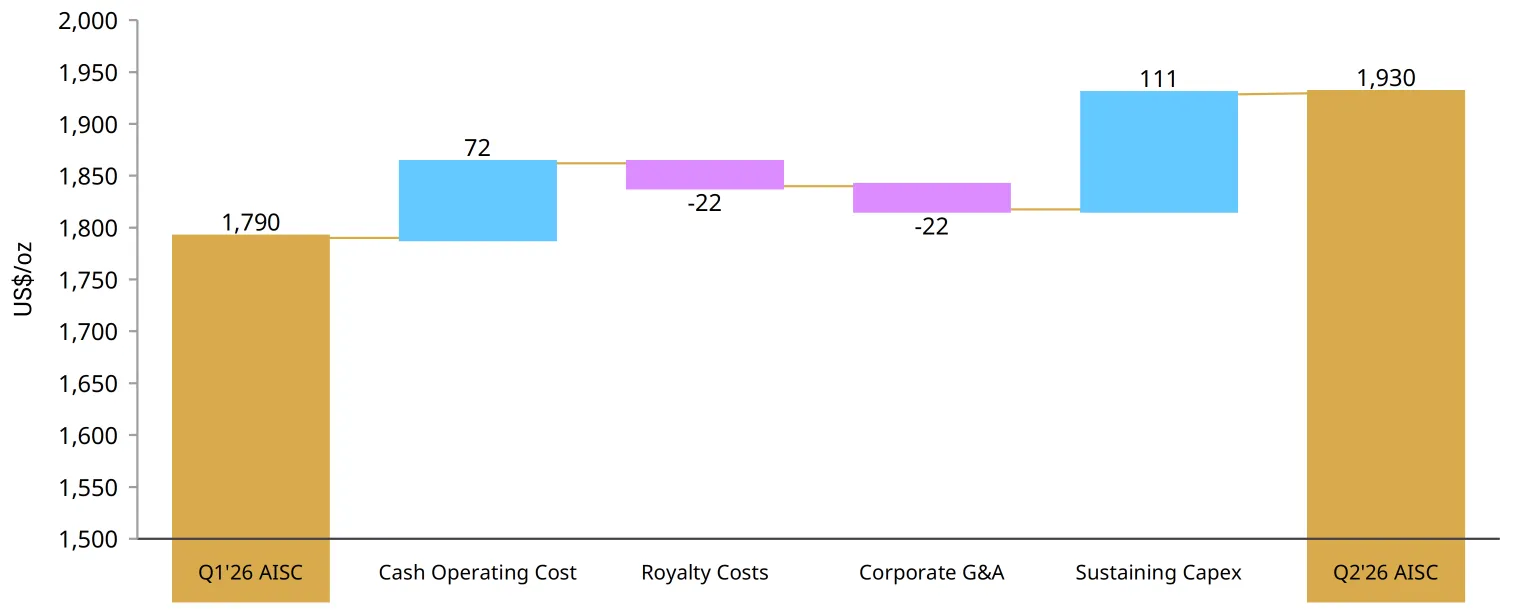
| All-in sustaining cost | 1,930 (record) |
| Average gold price | 4,512 |
| Average AISC margin | 2,582 |
Source: World Gold Council, Metals Focus Gold Mine Cost Service (November 2026)
How miners make money
The miner is a price taker. It does not earn money by marking up gold, because the price is set in the market. It earns the spread between the gold price it realises and its AISC per ounce.
Costs are at record levels. According to the World Gold Council and Metals Focus (November 2026), global average AISC reached a record US$1,930/oz in Q2 2026, up 22% year on year, with sustaining capital expenditure the largest driver at a record US$441/oz.
Margins remain exceptional. The average gold price of US$4,512/oz in Q2 2026 left average AISC margins at US$2,582/oz, down 16% on the previous quarter. That previous quarter was the peak: the World Gold Council's Q1 2026 analysis (August 2026) recorded a record AISC margin of US$3,076/oz.
What that means in practice. The average producer keeps more than half of the gold price as margin on each ounce, before tax, interest and growth spending. A producer in that position has no economic reason to sell below market.
How production costs are proven
Reconciled to audited accounts. AISC is a non-GAAP measure, so listed miners must reconcile it line by line to their audited financial statements. In the US this falls under the SEC's non-GAAP disclosure rules, and in Canada under National Instrument 52-112. Every dollar in a published AISC can be traced back to figures the auditors have signed off.
Industry averages are built bottom up. Averages such as the US$1,930/oz figure come from Metals Focus aggregating company disclosures across hundreds of operations through its Gold Mine Cost Service.
Private and smaller miners need their own evidence. Nobody has checked the numbers for you, so a lender will ask for three things. First, audited financial statements. Second, an independent technical report under NI 43-101 or the JORC Code, covering resources, reserves, mine plan and operating costs. Third, refinery settlement statements, which show how much doré was delivered, what it assayed and what was paid.

Why producer gold trades at spot. A producer with access to an LBMA refiner receives the market price for its payable ounces, less a small refining charge. With average margins above US$2,500/oz in Q2 2026, a genuine producer has no reason to sell large volumes through intermediaries at a meaningful discount. Any offer of bulk gold below market should be tested against refinery settlement statements, export documentation and chain of custody before anyone commits time or capital.
Who earns what along the chain
| Participant | How it earns money |
|---|---|
| Miner | The spread between the realised gold price and AISC per ounce. |
| Refiner | A refining charge per payable ounce, plus any metal recovered above the return rate agreed in the refining contract. |
| Bullion bank | Lending margins, gold lease income, trading, clearing and vaulting fees. |
| Physical trader | Logistics, location and timing spreads, and the financing it provides to producers. Not discounts to spot. |
| Royalty holder | A percentage of mine revenue or production, paid for life of mine with no further cost. |
| Streaming company | The difference between the spot price and the fixed or percentage price it pays for each streamed ounce. |
Royalty financing
How it works. A royalty company pays the mine owner a lump sum today in exchange for a percentage of future revenue or production from a defined property. The miner gets non-dilutive capital with no fixed repayment schedule. The royalty holder gets exposure to gold prices, reserve growth and production without carrying operating or capital cost risk.
The main types. As Franco-Nevada explains, revenue-based royalties are calculated on the value of production with deductions defined in the contract. The most common in gold is the net smelter return (NSR) royalty, a percentage of what the operator receives from the refiner after refining and transport deductions. Gross royalties allow fewer or no deductions. Profit-based royalties such as the net profits interest (NPI) pay a share of operating profit, often only after the operator has recovered its capital.
Security of tenure. Royalties are often registered on title to the mineral rights. Franco-Nevada's 2026 asset handbook notes that, where recognised, registered royalties will generally survive a reorganisation of the operating company, which is a large part of their appeal to financiers.
When royalties fit. Royalties suit developers that need construction or expansion capital, operators refinancing expensive debt, and owners who want to monetise part of a long-life asset without selling equity. Pricing turns on reserve life, jurisdiction, AISC position and the quality of the technical report.
Stream financing
How it works. In a stream, the financier pays a large upfront deposit and then buys a fixed percentage of a mine's future metal output at a low ongoing price. The miner delivers ounces, or metal credits, as they are produced. The streamer earns the gap between the spot price and its ongoing payment, and recovers the deposit over time through that gap.
Two common pricing models. The ongoing payment is either a percentage of spot or a fixed price per ounce. In February 2026, Wheaton Precious Metals agreed a US$4.3 billion stream with BHP on its share of Antamina silver, with ongoing payments of 20% of the spot price per ounce delivered. At Mount Milligan, Royal Gold holds the right to 35% of payable gold at a cash price equal to the lower of US$435/oz or the market price.
Streams fund development too. Streams are not only for large producers. In April 2026, Wheaton signed a gold and silver stream with KGL Resources on the Jervois project in Australia, including early deposit instalments to keep the development schedule on track before construction.
Stream or royalty. Streams usually involve larger cheques and a contractual delivery obligation, so they behave more like a metal-denominated financing. Royalties are simpler, carry no ongoing payment and sit on title. Both are typically subordinated to, or negotiated alongside, senior project debt, so the full capital stack must be planned together.
| Feature | Royalty | Stream |
|---|---|---|
| Upfront payment | Lump sum purchase price | Upfront deposit, often in instalments |
| What the financier receives | % of revenue or production | % of payable metal output |
| Ongoing payment by financier | None | % of spot or fixed price per ounce |
| Security | Often registered on title | Contractual, usually with security package |
| Effect on the miner | Non-dilutive, no fixed repayment | Non-dilutive, repaid in metal over mine life |
Prepayments, gold loans and inventory finance
Prepayments and offtakes. A refiner or trader advances cash against future deliveries of doré or refined gold, repaid in metal or from sale proceeds. Pricing, return rates and delivery schedules sit in the offtake agreement, and the lender takes security over the contract and the metal.
Gold loans from bullion banks. A bullion bank lends physical gold, which the producer sells for cash and repays later from production. It is often paired with hedging so that repayment risk is matched to output.
Inventory and borrowing base facilities. Traders and refiners finance doré in transit, metal in process and bars in vault against a borrowing base tied to assay and warehouse records. This is the core of physical gold trade finance and sits within our structured trade and commodity finance work.
What lenders need to see
Proof of production. Refinery agreements, doré shipment records, assay certificates and settlement statements that tie claimed output to delivered ounces.
Proof of cost. Audited accounts and an AISC build that reconciles to them, supported by an NI 43-101 or JORC technical report.
Proof of provenance. Export licences, transport records and chain of custody documentation consistent with the LBMA Responsible Gold Guidance, which every Good Delivery refiner must apply to its suppliers.
A capital stack that matches the metal flow. Senior debt, prepayments, royalties and streams sized together, with repayment linked to deliveries and a clear price risk plan. Our commodity finance engagement deliverables set out how we build that credit file, and producers who need a complete package can start with the Lender-Ready Package.
Build your gold financing around verifiable ounces
Financely structures gold prepayments, offtake-backed facilities, inventory financing and royalty or stream processes for producers and physical traders, with transactions from USD 2 million. We prepare the credit file financiers expect and take it to the right capital. See how our structured debt advisory gets deals financed.
Frequently asked questions
What is gold trade finance?
Gold trade finance covers the funding of gold as it moves from mine to refiner to market, including prepayments, offtake-backed facilities, inventory and in-transit financing, gold loans, royalties and streams. Facilities are secured on traceable ounces and repaid from delivery or sale proceeds.
What is gold doré?
Gold doré is a semi-pure bar of gold and silver poured at the mine. Its gold content varies widely by mine. It is shipped to an accredited refiner, assayed and refined into bullion of at least 99.5% purity, and the mine is paid for its payable ounces less a refining charge.
What is AISC in gold mining?
All-in sustaining cost is the World Gold Council's standard measure of the full cost of producing an ounce of gold, including operating costs, royalties, sustaining capital and overheads. In Q2 2026 the global average reached a record US$1,930/oz according to the World Gold Council and Metals Focus.
What is the difference between a gold royalty and a gold stream?
A royalty pays the holder a percentage of revenue or production in return for a one-off purchase price, with no further payments. A stream combines an upfront deposit with the right to buy a share of the mine's metal at a low ongoing price, such as a percentage of spot or a fixed price per ounce.
How can a lender verify a private miner's production costs?
By reviewing audited financial statements, an independent technical report under NI 43-101 or JORC, and refinery settlement statements showing doré delivered, assayed and paid for. Together these tie claimed costs and output to documented evidence.
This article is general information only and is not legal, tax or investment advice. Market figures and transaction terms are as published by the cited sources at the dates shown. Financely is an advisory and arranging firm, not a lender or broker-dealer. Any financing is subject to underwriting, due diligence, credit approval, documentation and conditions precedent, and no outcome or timeline is guaranteed.
Before you submit
Your deal, assessed by people who close
Your financing request goes straight to the principal. You receive a written diagnosis, the proposed structure and a one-off retainer before any work starts.
Recent mandates include a USD 150m revolving credit facility and a USD 12m acquisition closed in 21 days. We are an advisory and arranging firm, not a lender, and you close directly with the lender.
- Principal-led
- Fees in writing
- KYC and AML first
- Structured Debt
- Trade Finance
- Project Finance
- Acquisitions

Financely is an advisory and arranging firm, not a lender or broker-dealer. All financing is subject to KYC, AML, due diligence and lender credit approval. No outcome or timeline is guaranteed.